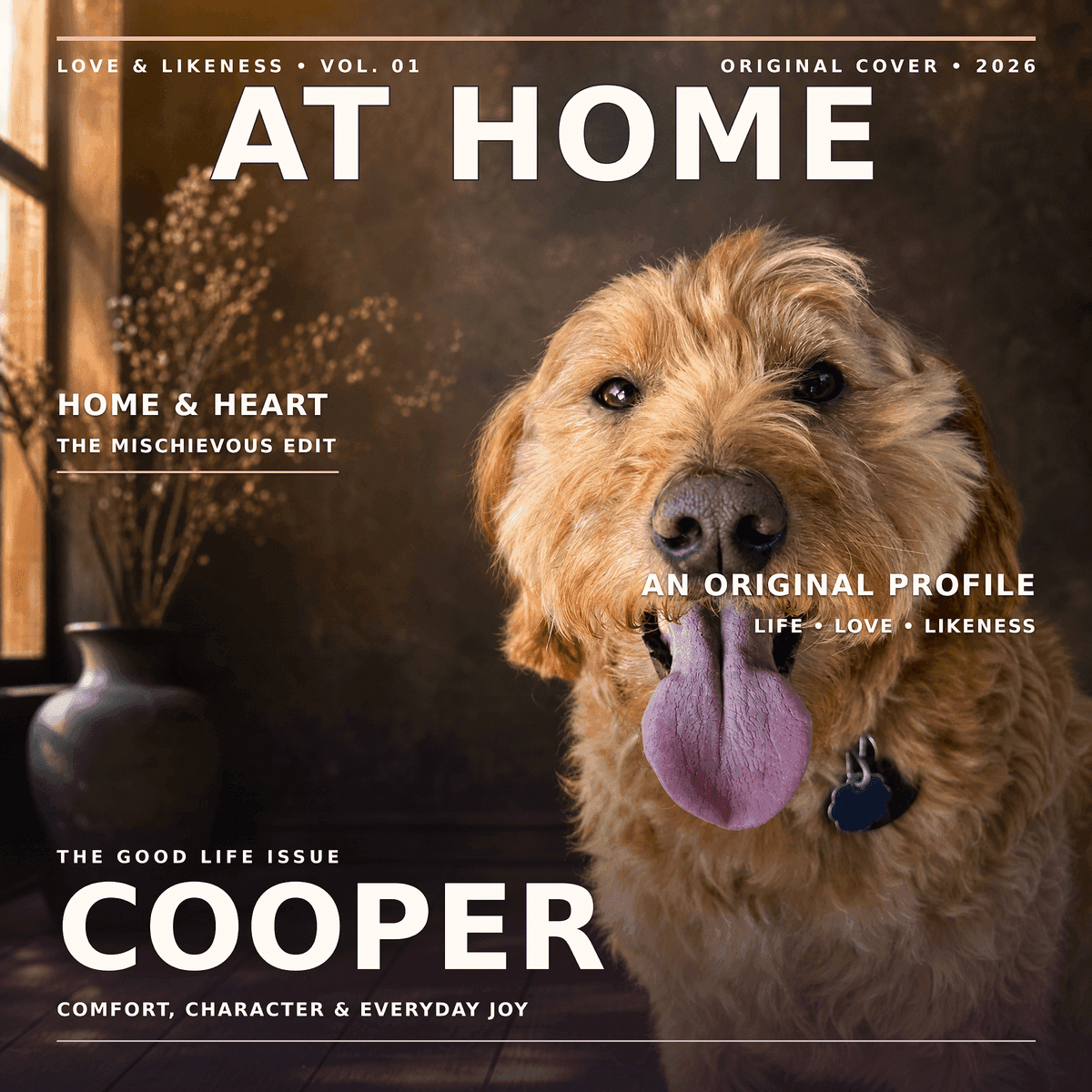
A dog magazine cover and a pet trading card share the same joke: this animal is important enough to have a public career. The difference is presentation. A cover celebrates personality through headlines and a bold portrait; a trading card turns habits, nicknames, and questionable statistics into collectible lore.
Love & Likeness offers both as single-portrait styles. The image model creates the pet and art-directed composition without lettering; the site then adds the selected original masthead or sports-card frame, your pet's name, and the chosen details with deterministic typography so every important word stays crisp.
Choose a cover-worthy portrait
A magazine layout needs one unmistakable focal point. Choose a portrait with a clean silhouette and visible eyes. The dedicated Magazine Cover style lets you choose an original Personality, Adventure, Home & Heart, or Style Icon publication direction; that selection guides both the photograph and the crisp masthead and cover lines. Classic Portrait remains a quieter starting point for a personalized layout you plan to assemble yourself.
Avoid using the busiest image merely because it feels dramatic. Headlines, issue information, a title, and perhaps a badge still need space. A simpler background usually produces a more convincing editorial cover.
See your pet in a free preview
Upload one clear photo, pick a character, and judge the likeness yourself before paying anything.
Write headlines that sound like the pet
Use one large cover line and two or three smaller ones. A food-obsessed dog might lead with 'The Treat Economy,' while a cat could promise 'The Definitive Guide to Closed Doors.' Specific habits make the design personal; generic phrases such as 'Best Dog Ever' could belong to anyone.
Keep the pet's real name as the clearest personalized element. Avoid copying the exact title, typography, logo, or trade dress of a real magazine. An original fictional publication is funnier and avoids making the design look like counterfeit branded material.
Build a trading card with meaningful stats
A card front needs the portrait, pet name, and a clear sports identity. The All-Star Trading Card style lets you choose baseball, basketball, football, soccer, or hockey, then pairs that selection with a sport-specific position, player number, and one of three original colorways.
Those bounded choices are more reliable than an open team-name box: the selected sport guides the setting, while the deterministic overlay keeps the number and position crisp and avoids accidentally copying a real club, league, uniform, or card company.
Invented statistics are part of the charm: nap efficiency, treat detection, doorbell defense, or sock-recovery percentage. Make it obvious that the numbers are playful rather than genuine health, breed, or competition records. Use large enough type that the card remains readable when printed small.
Layout and print without losing the face
Place text in the negative space around the portrait, maintain strong contrast, and limit the number of typefaces. A translucent color block can make a headline readable without covering the pet. Keep every important element inside the printer's safe area, especially on a trading card with rounded corners.
The 2400px download is well suited to screen sharing and small prints. If you order a physical card through a third party, use its exact bleed and trim template and inspect the proof. Love & Likeness currently supplies the digital portrait, not a printed magazine or manufactured card.
Why these work as portrait styles
Magazine-cover and trading-card themes fit the existing single-portrait product: one upload, one preview, one finished download. The All-Star Trading Card style creates the framed collectible composition; a deterministic finishing step adds the readable labels after generation.
That keeps the offer simple. You are still buying one finished digital portrait, not entering a separate card designer or physical-fulfillment flow. Personalization stays deliberately bounded: magazine buyers select an original issue direction, while card buyers select a supported sport, position, number, and colorway. The preview, pricing, and download format remain the same as any other single portrait.